Wide Stops and Wider Trails

Expectancy is the ultimate "truth" in trading because it represents the average amount you can expect to make or lose per trade over a large sample.
It combines your Win Rate with your Risk-to-Reward (R:R) ratio to determine if your system has edge.
The Expectancy Formula:
E=(Win % × Average Win)−(Loss %×Average Loss)
As long as your Average Win is significantly larger than your Average Loss, your system has a positive expectancy.
If a coin toss pays you $3 for heads and costs you $1 for tails, you can keep betting on heads and you have a positive expectancy. With a 50% probability, even if you lose multiple times in a row, the mathematical edge ensures you'll be profitable over a large sample of tosses.
Tight Stops and Volatility
Knowing expectancy, traders generally aim to keep tight stops and get whipsawed till they catch a momentum leg that makes up for their losses.
This means that they, by default, need to trade more liquid names or they run into the risk of not finding an exit on the way down incase the stock starts circuiting.
For example, imagine a trader taking 7 losses of 2% each and then making 20% in his 8th trade.
Assuming this distribution, despite just winning 1 trade in 8 (12.5% win rate), this trader is profitable.
Also, stop set at 2% vs 10% means you can technically carry a position 5x larger for the exact same total risk.
And the same applies for % based trailing systems.
This along with the fact that the math of recovery is unforgiving, i.e., a 50% loss requires a 100% gain just to get back to even, makes it a no brainer to have tight stops with massive positions to scalp out positions.
Putting Together My Findings And My Personality
But this style of speculation does not suit me.
All of this seems logical, and applying this logic to speculation seems a bit too easy when looking at cherry picked charts that showcase high momentum price trends holding above the 10 and 20 day moving averages.
In reality, majority of the stocks have much deeper pullbacks, often undercutting these short term averages multiple times on their way up.
Here's an example:
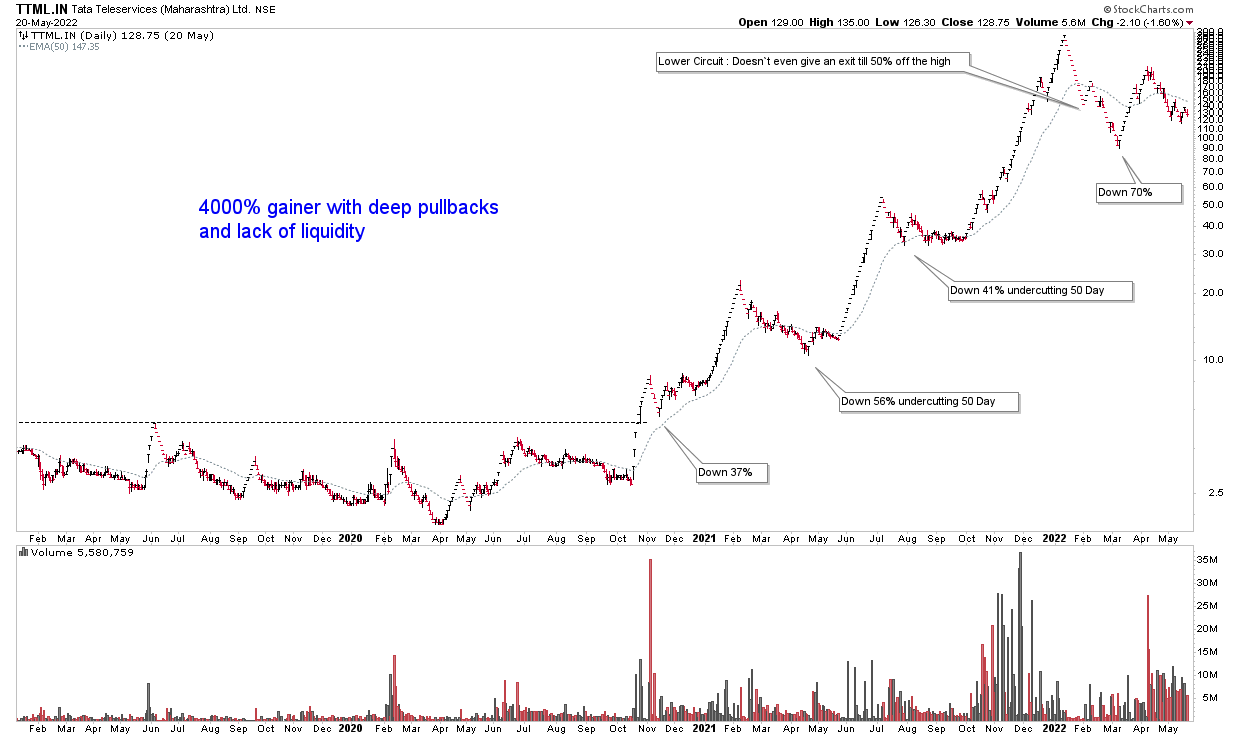
My studies indicate that if you wish to profit from a stock going up 3x to 7x in a 4 - 6 quarter bull cycle, in most cases you have to be prepared for AT LEAST one 30% pullback off the high and multiple undercuts of the 50 Day Moving Average.
In the case of multi year trends, stocks could underperform the benchmark for 4 - 8 quarters with volatility that will make the daily chart (and sometimes even the weekly) look like a chop fest.
Despite this, one glance at a set of stock charts makes it evident that momentum as an anomaly surely does exist in the markets.
Can one find a way to speculate on price momentum without chasing short term momentum?
This reminded me of something Vijay Kedia said about the stock market:
KYS (Know Yourself) is more important than KYC.
I could speculate a lot better once I understood that my personality is once that has to block out the noise and manage risk by having a small percentage of 'Capital at Risk' per bet while still having my stops and trails wide.
The cost of this approach? Small positions.
And while that can kill your dreams of being extremely concentrated in the best stock of the year and making 100s of % on your capital, to me it felt like a more sustainable way of doing business in the long run.
Not just that, but it actually gave me the optionality of holding onto a position for multiple years if the story kept developing along the way.
My studies show that you can profit with stops as wide 30% - 50% as long as you buy the right stocks at the right point of the cycle.
And if that seems unbelievable, think about how investors operate in this space.
A profitable investor is someone who's stop loss is 100% (in the traditional sense of stop loss) and is expecting to make multiple 100s of percent on the way up.
I don't mean having stops wide for the sake of it, but having stops that accommodate the volatility that comes along with the asset you're speculating on.
As long as your expectancy is positive, it should yield you a profit in the long run.
Buffet has himself said the following:
"Take the probability of loss times the amount of possible loss from the probability of gain times the amount of possible gain. That is what we’re trying to do. It’s imperfect, but that’s what it’s about."
All my findings show that huge moves often has deep pullbacks that standard retail trading strategies cannot survive the volatility.
Even Jerry Parker, one of the OG turtle traders has said the following:
"I'm just trying to take that benefit that trend following gives me and say, hey, just loosen up. Lighten up... In order to maximize that profit, you will have to allow the market to have a lot of volatility."
His goal is to stay in the trade through 10–20% drawdowns to capture the 200–500% "outlier" moves.
For this, he uses stops and trails as wide as 3x - 5x the ATR.
My understanding is that most of the profit in trend following comes from the "Right Tail" of the distribution; the top 5% of trades.
If your stops are tight, you will almost certainly be stopped out of the "Big One" during its first minor correction.
Hope this gives you an idea of where I'm coming from.
Also, I believe that just like with program trading, AI too will bring in even more volatility into the financial system.
Stocks will sill trend, but the probability of "shakeouts" increases even more.
This are my findings and my approach.
Once again, as Vijay Kedia said, knowing yourself is crucial in the market.
My goal is survival first.
I suggest that you formulate your approach based on your research and your personality.
To end, I'd like to quote one of the GOATS:
"There are old traders and there are bold traders, but there are very few old, bold traders."