P/E Expansion and Market Leaders

Imagine identifying a company that will grow it's earnings, being right, and still losing money. Surprising? Not if you understand the workings of the P/E multiple.
What is price? Simply put;
Price = P/E × EPS
While the math is straightforward, it’s helpful to understand what these two variables represent in the real world:
EPS (Earnings Per Share): This is the fundamental side of the equation, representing the actual profit a company generates. When a company expands, increases sales, or cuts costs, the earnings rise.
P/E Ratio (The Multiple): This is the psychological side of the equation. It reflects what investors are willing to pay for every dollar of those earnings. The P/E ratio shifts with market sentiment, expanding or contracting based on the 'mood' of investors.
Once you understand these variables, it becomes a lot easier to understand why the expansion or contraction of the P/E multiple can make or break your returns.
How P/E Contraction Neutralizes Growth
Imagine a company where the earnings go up by 3 times but the P/E drops by 3 times. The result is that price stays exactly the same.
Price = P/E ↓ x EPS ↑ = No Change
So despite the company making a profit, the price cannot perform. This is the underlying phenomena that explains how you can be right on earnings growth and still see no price appreciation.
The Dreaded 'Time Correction'
This was best explained by Mr. Rakesh Jhunjhunwala. He explained that time is the enemy of an overvalued stock. He famously said that while Hindustan Unilever was a great company, it was a "bad investment" in 2000 because you were paying for 10 years of future growth upfront.
Hindustan Unilever’s stock price did not break its 2000 high till 2011 even though the company remained the king of Indian FMCG.
The reason? P/E Contraction.
In 2000, HUL entered the new millennium as the ultimate 'market darling'. Its P/E ratio had soared to an extreme level (around 80–100x), as investors believed it was the safest bet in India. However, the market realized that 80x multiple was unsustainable and by 2010, the P/E had contracted towards 25–30x.
The chart below shows how this played out.
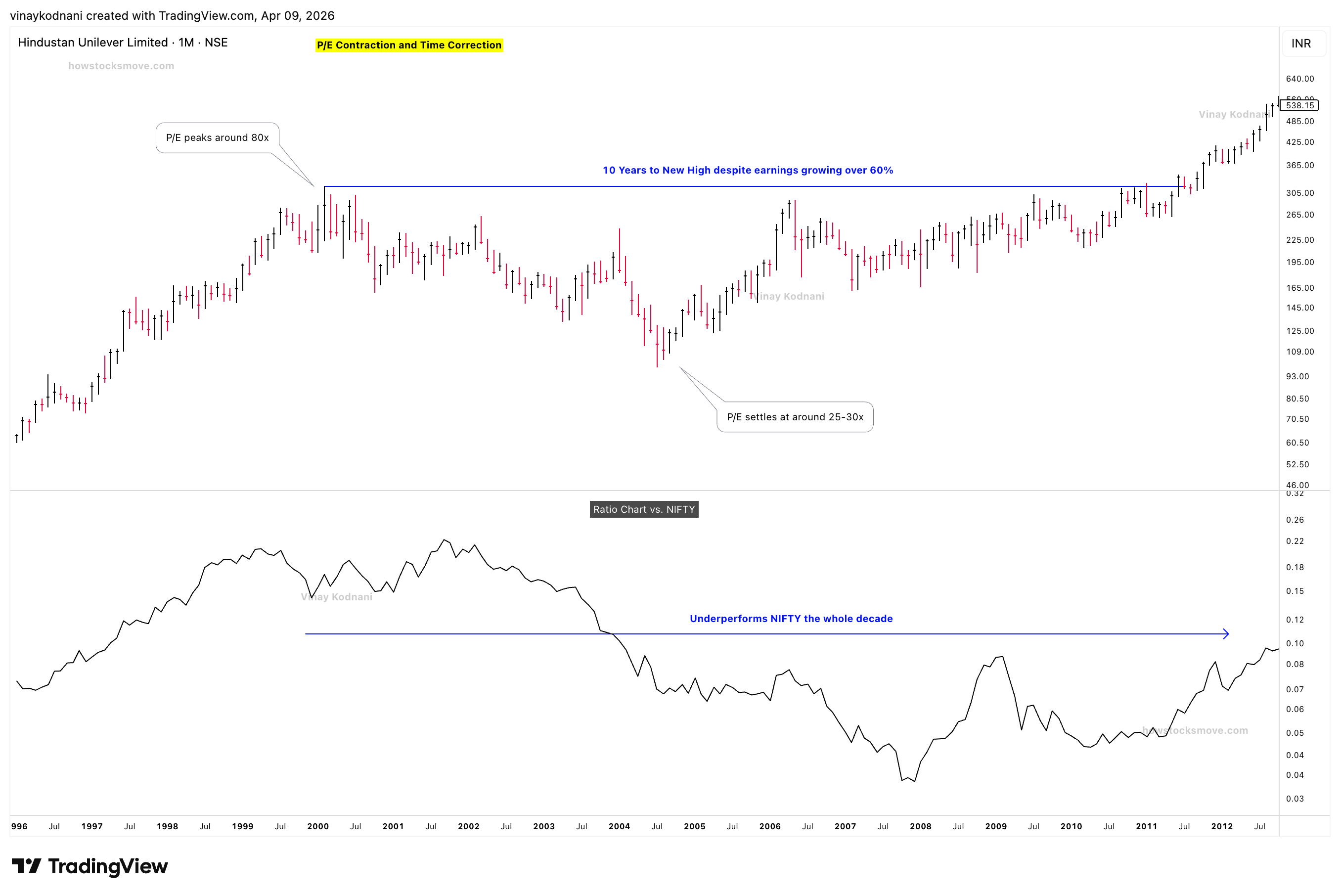
This is one of the simplest examples I've come across in my research that shows why buying at 'any price' can be very costly in 'time', even if what you're buying is 'quality'. Here is what I've found works instead.
Outsized Returns: P/E Expansion and Earnings Growth
A 'multi-bagger' rarely relies on earnings growth alone. The most explosive returns occur when the P/E ratio expands alongside growth in earnings.
Imagine a high-growth company:
Year 1: EPS is $1.00 and the P/E is 30x.The stock price is $1 x 30 = $30.
Year 5: The company now dominates its industry, and it's EPS has surged to $10 (This represents the fundamental component).
Because the company has proven it has a 'moat', investors are now even more optimistic and are willing to pay a P/E of 50x (This represents the sentiment or "multiple expansion" component).
The Result: The new price is $10 × 50 = $500.
In this scenario, while earnings grew 10x (from $1 to $10), the stock price skyrocketed 16.6x (from $30 to $500). This demonstrates how P/E expansion acts as a force multiplier for earnings growth.
The bottom line is that paying 'any price' for growth is rarely a sustainable strategy (unless you are sure of the company and don't mind waiting a decade). To capture outsized returns, the ideal setup is identifying a stock with strong, persistent earnings growth that is currently trading at a relatively low P/E multiple. This creates the runway for outsized returns.
Speculative Frenzies: What's High Can Go Higher
While the logic of valuation applies over the long term, the market can do whatever it likes in the short run. A stock with a P/E of 100x can easily surge to 200x or even 300x within a few quarters. For anyone studying price behavior, this reality cannot be ignored.
In periods of extreme euphoric 'melt-ups', the market often abandons fundamentals in favor of the Greater Fool Theory, i.e., the belief that one can profit from an overvalued asset because there will always be someone else (a 'greater fool') willing to pay an even higher price, regardless of underlying value.
My research suggests that while these moves usually require a powerful catalyst for both the stock and the sector, the price can skyrocket by hundreds of percent. It is possible to speculate in these scenarios, provided you adhere to the Golden Rule.
The Golden Rule: Cut Your Losses.
This is where risk management and stop-losses become non-negotiable. While many investors look down on traders, you must never speculate in high P/E stocks without a defined exit strategy. In fact, you should never speculate at all without stops. It is far better to learn through the 'death by a thousand cuts' of small, controlled losses than to blow up your entire account on a few bad trades.
Yes, high P/E stocks can go significantly higher in bull markets, and yes, you can profit from them, but having a sell strategy is crucial. It can be painful to give back a parabolic move or, worse, book a loss after watching a stock soar, but you must remain disciplined.
Always use a stop-loss. You never know exactly when the tide will turn.
Once you have understood how the P/E multiple can impact returns, read my findings on Relative Volume and Market Leaders to train your eyes to spot stocks that make massive moves.
You should also read:
ATRP and Market Leaders
Ever wondered why the same percentage gain on two stocks can look completely different? Which of the following do you think would be easier to hold on to? Enter: Volatility In the world of speculation, volatility is the living embodiment of the idea that the…
Relative Volume and Market Leaders
In modern times, speculators often say volume is "spoofed" because of high-frequency algorithms that place massive buy or sell orders and then cancel them in milliseconds, creating a fake appearance of demand to manipulate prices without ever intending to trade. Additionally, a huge portion of…